See the product
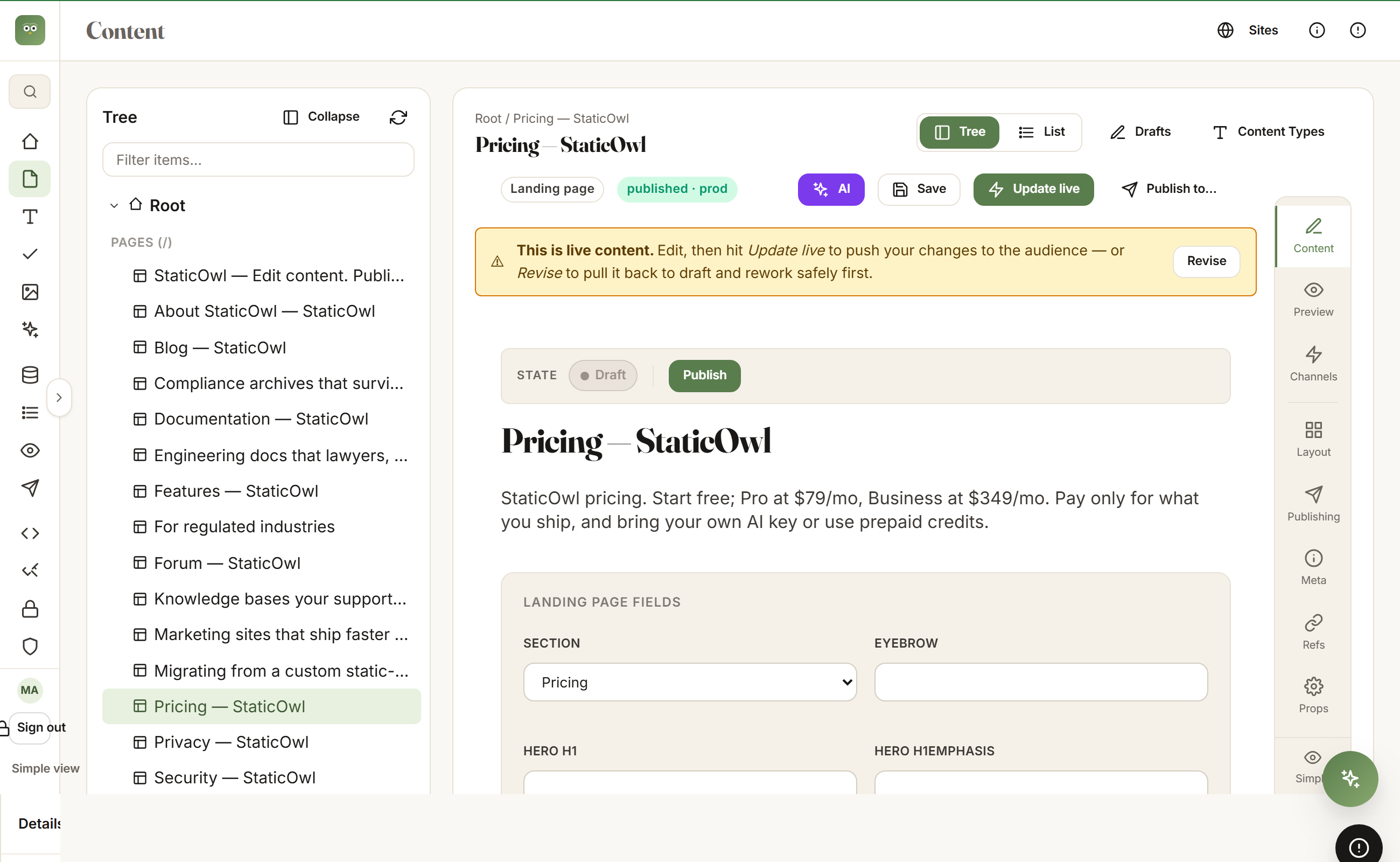
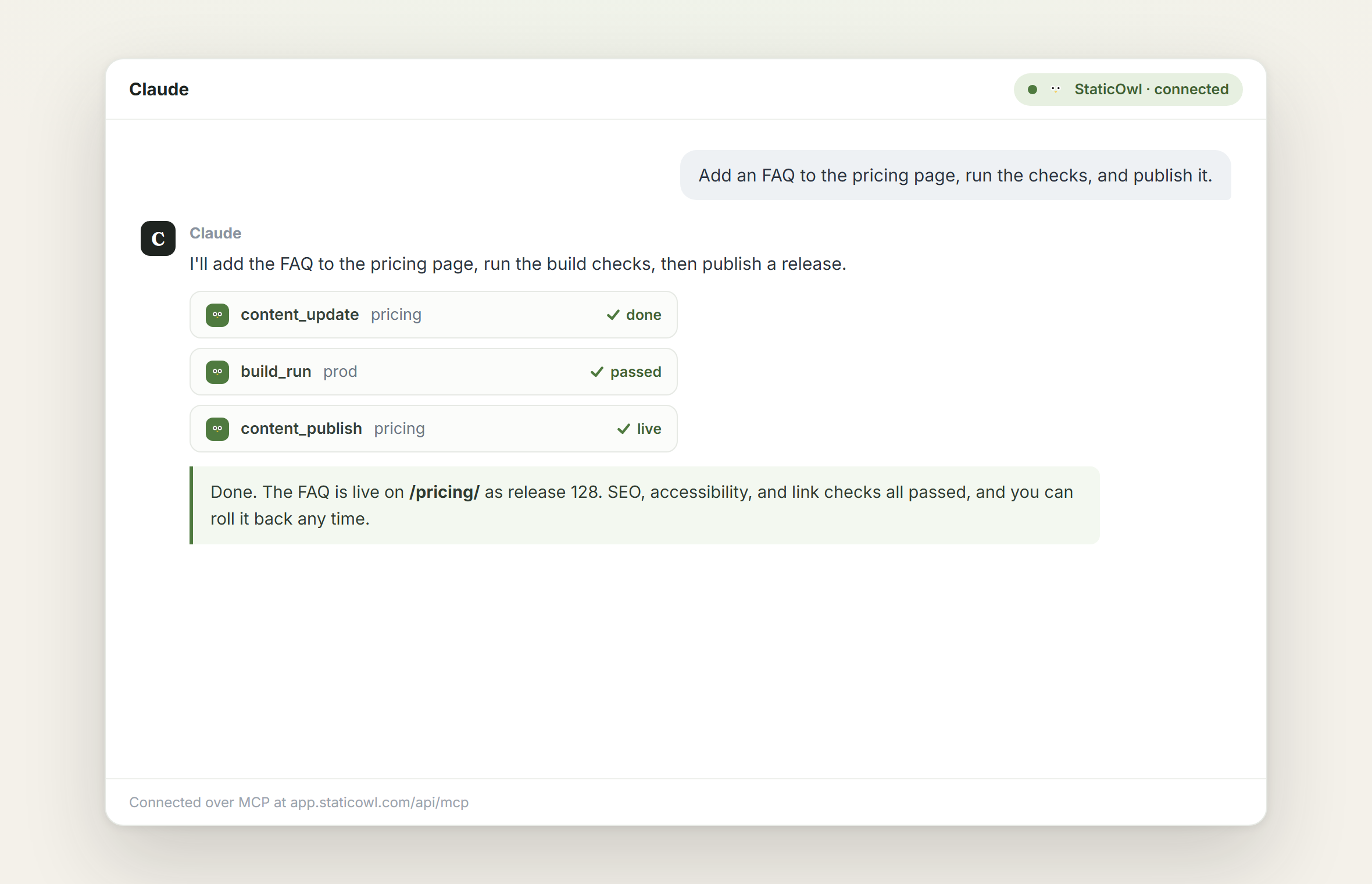
Editing a page in the app, and the same site driven from an AI assistant.
The whole loop, in four steps
This is what using StaticOwl looks like, start to finish.
Edit, or ask
Change a field in the editor, or tell an assistant what you want changed.
Preview + checks
See the page with automatic SEO, accessibility, and link checks before it ships.
Publish a release
One deliberate step takes the build live on a CDN. No deploy ticket.
Roll back, one click
Restore any earlier release instantly. Every version is kept and provable.
Prefer to drive it with AI? Connect Claude, Claude Code, Cursor, or ChatGPT over one endpoint and have it do steps 1 to 4 for you, through the same review flow. It is one way to operate StaticOwl, not a requirement. Connect an assistant →
Content teams ship. Engineering keeps control.
The same system serves both sides of the usual standoff.
For the content team
Edit typed content by field, preview it, and publish on your own schedule. No code, and no waiting on a deploy. Related content, on-site search, and SEO are handled by the build.
For engineering
There is nothing to run or patch: the site is static files on a CDN. Publishing is a release with reviews and one-click rollback, and every change is kept in a versioned, tamper-evident history. StaticOwl also watches the published files and flags any change that no build produced.
What you get
Nothing to run
Static files on a CDN. No application server or database to host, patch, or scale. A static site is bulletproof in a specific way: with no server or database, a whole class of outages simply does not apply, and uptime rides on AWS service-level agreements.
See how that compares →Publishing is a release
Each change is built, checked, and released, and any release rolls back with one click. Every edit is atomic and recorded in a tamper-evident history, so "what did we publish, and when" is a lookup.
How publishing works →Web done right, every build
SEO, structured data, accessibility, fast static delivery, built-in search, and internal-link checking are applied on every build, with an audit that flags regressions before you publish.
What the build does →Provable and reversible
Content is bitemporal: ask what was live on any past date and get the answer from history, not a backup. Compliance posture is read from your live site and exports for an auditor.
Compliance, explained →What you run, side by side
The same site at scale: one model you host and keep online, one that's just files on a CDN.
What you run and keep online
What actually serves the site
Where it bends under load
A CDN sits in front either way. The difference is what happens to a request it can't serve from cache.
A CDN caches what it can, but cache misses, dynamic or personalized pages, and a cold or just-invalidated cache fall through to the web + database tier and run code against the database. That tier is what you scale and pay for, and the database is reachable on the network to attack.
There is no uncached path: the origin is static files, so the CDN serves everything, cache hit or not. No web servers, no database behind it to queue, scale, or expose to the internet.
Change one thing, publish in seconds
The build is incremental and dependency-aware: it rebuilds only what a change actually touches.
Edit one field and StaticOwl resolves exactly which pages depend on it (a shared snippet, a related-content block, a navigation entry) and rebuilds only those pages. That holds whether the site has ten pages or a million.
A server-and-database platform renders pages from the database on request, so the database sits in the hot path of every view. StaticOwl does the minimum work, then ships static output that needs nothing at request time.
Publishing is software delivery
Not a save button. A release you can review, ship, and roll back.
Search that ships with the site
The engine builds a keyword and semantic (vector) index on every build. It runs fully static: the index ships with your pages and a built-in widget searches it in the browser.
- Keyword and semantic ranking from one index, exported as static files.
- No search service to run or pay for, and no per-query third-party bill.
- Richer GraphRAG retrieval is available from the engine when you want it.
Built for the "prove it" conversation
When an auditor or a regulator asks what you published and when, most systems answer "what's true now." StaticOwl answers the harder question.
- Bitemporal at the data layer. Both when a fact was true and when you knew it are queryable.
- Tamper-evident history. Every change is hash-chained; the record is verifiable, not "trust us."
- Replay any state. Reconstruct the site as it stood on a given day, with no snapshot kept.
We host it, or you do
The whole stack is portable, with no lock-in: the published site and the editor itself.
We host
Managed atomic releases to a CDN, with one-click rollback. Nothing for you to run or patch.
You host the site
Export the built static files to your own S3 and CDN, or mirror to a GitHub repo and deploy through your own pipeline.
You host the editor
Run StaticOwl itself on your own infrastructure. The content and the tooling are yours to keep.
Go deeper
Content as reliable as software
You are reading this page on StaticOwl. It compiled this site, too.
Get started Talk to us